


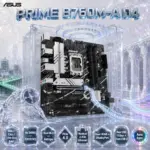
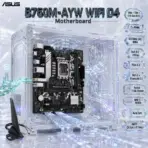
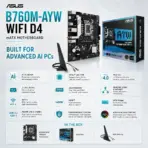
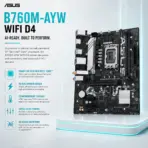
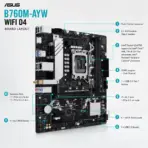

ASUS B760M-AYW WIFI D4 Micro-ATX Motherboard, LGA 1700, 2 x DIMMs DDR4 5333Mhz (OC), PCIe 4.0, Dual M.2 64Gbps, WiFi 6, Bluetooth 5.2, 2.5Gb Ethernet, HDMI 2.1, 14th / 13th / 12th Gen 

149 $

BRAND-NEW SEALED ~ 1 YEAR WARRANTY

Expert Features

  • Intel LGA 1700 Upgrade Platform : Supports compatible 14th, 13th and 12th Gen Intel Core processors, plus Pentium Gold and Celeron CPUs—solid flexibility for gaming, office, content and productivity builds.
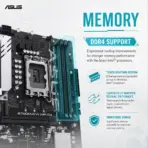
  • High-Speed DDR4 Tuning : Two DIMM slots support up to 64GB of dual-channel DDR4 memory, with overclocked speeds reaching 5333MT/s on compatible CPU and memory configurations plus Intel XMP support.
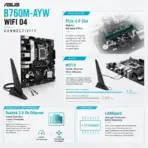
  • PCIe 4.0 Graphics Bandwidth : The full-length PCIe 4.0 x16 slot is ready for compatible modern graphics cards, while two additional PCIe 4.0 x1 slots handle expansion cards.
  • Dual 64Gbps M.2 Storage : Two PCIe 4.0 x4 M.2 slots support 2242, 2260 and 2280 NVMe SSDs, giving your operating system, games and applications serious launch-speed energy.
  • Four SATA 6Gbps Ports : Connect multiple SATA SSDs and hard drives, with Intel Rapid Storage Technology support for SATA RAID 0, 1, 5 and 10 configurations.
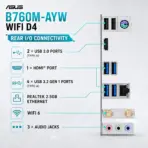
  • WiFi 6 and Bluetooth 5.2 : Integrated dual-band 2.4GHz and 5GHz WiFi 6 keeps the system cable-light, while Bluetooth 5.2 supports compatible wireless peripherals and accessories.
  • Realtek 2.5Gb Ethernet : Faster-than-Gigabit wired networking delivers stronger local transfers, downloads and low-latency connectivity when paired with compatible 2.5Gb network hardware.
  • 4K 60Hz HDMI Output : The HDMI 2.1 connection supports up to 4K at 60Hz when the installed processor includes compatible integrated graphics.
  • Ten-USB Connectivity Potential : Six rear USB ports are ready immediately, while internal headers support four additional front-panel USB connections through a compatible chassis.
  • Aura Sync Expansion : Two Addressable Gen 2 headers and one traditional Aura RGB header support synchronised lighting for compatible strips, fans, cases and cooling hardware.
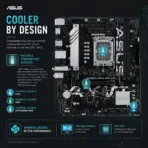
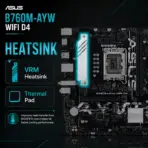
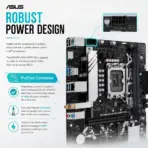
  • Strong Power and Cooling Foundation : An 8-pin ProCool CPU power connector, DIGI+ VRM control, VRM heatsink, PCH heatsink and configurable fan controls help maintain stable operation.
  • Builder-Friendly ASUS Protection : Q-DIMM, Q-Slot, Q-LED Core, SafeSlot Core, LANGuard, overvoltage protection and stainless-steel rear I/O make assembly and troubleshooting much less painful.

Expert Specs

The following specifications are based on ASUS’s official B760M-AYW WIFI D4 technical-specification page.

Specification Value
Brand ASUS
Model B760M-AYW WIFI D4
Product Type Micro-ATX Motherboard
CPU Socket Intel LGA 1700
Supported Processors Intel Core 14th, 13th and 12th Gen; Pentium Gold; Celeron
Turbo Technology Intel Turbo Boost 2.0 and Turbo Boost Max 3.0, Depending on CPU
Chipset Intel B760
Memory Slots 2 × DDR4 DIMM
Maximum Memory 64GB
Memory Architecture Dual Channel
Supported Memory Speeds DDR4 5333(OC), 5066(OC), 5000(OC), 4800(OC), 4600(OC), 4400(OC), 4266(OC), 4000(OC), 3733(OC), 3600(OC), 3466(OC), 3400(OC), 3333(OC), 3200, 3000, 2933, 2800, 2666, 2400 and 2133
Memory Type Non-ECC, Unbuffered DDR4
Memory Profile Support Intel XMP
Memory Compatibility Note Supported speed and module configuration depend on the installed CPU and memory
Display Output 1 × HDMI
HDMI Specification HDMI 2.1
Maximum Display Resolution Up to 4K at 60Hz
Integrated-Graphics Requirement Video output depends on the installed CPU
Main Expansion Slot 1 × PCIe 4.0 x16
Additional Expansion Slots 2 × PCIe 4.0 x1
Total M.2 Slots 2
M.2_1 PCIe 4.0 x4; Supports 2242, 2260 and 2280 SSDs
M.2_2 PCIe 4.0 x4; Supports 2242, 2260 and 2280 SSDs
Maximum M.2 Bandwidth Up to 64Gbps per Slot
SATA Ports 4 × SATA 6Gbps
SATA RAID Support RAID 0, 1, 5 and 10 Through Intel Rapid Storage Technology
Wired Network Realtek 2.5Gb Ethernet
Network Protection ASUS LANGuard
Wireless Network WiFi 6, 802.11a/b/g/n/ac/ax
Wireless Bands 2.4GHz and 5GHz
Bluetooth Bluetooth 5.2; Version May Vary by Wireless Module
Rear USB Ports 6 Total
Rear USB 3.2 Gen 1 4 × Type-A
Rear USB 2.0 2 × Type-A
Front USB Support 4 Additional Ports
Front USB 3.2 Gen 1 1 Header Supporting 2 Ports
Front USB 2.0 1 Header Supporting 2 Ports
Audio Codec Realtek 7.1 Surround Sound High-Definition Audio Codec
Audio Playback Up to 24-Bit / 192kHz
Audio Features Jack Detection, Multi-Streaming and Front-Panel Jack Retasking
Audio Design Audio Shielding, Premium Audio Capacitors and Dedicated Audio PCB Layers
7.1 Audio Requirement Requires a Chassis With an HD Audio Front-Panel Module
Rear HDMI 1
Rear WiFi Module 1
Rear Ethernet Port 1 × Realtek 2.5Gb RJ-45
Rear Audio Jacks 3
Rear PS/2 Port 1 × Keyboard / Mouse Combo
CPU Fan Header 1 × 4-Pin
Chassis Fan Header 1 × 4-Pin
Main Power Connector 1 × 24-Pin
CPU Power Connector 1 × 8-Pin +12V ProCool
Addressable RGB Headers 2 × Addressable Gen 2
Aura RGB Header 1
Clear CMOS Header 1
COM Port Header 1
Front-Panel Audio Header 1 × AAFP
S/PDIF Output Header 1
Speaker Header 1
SPI TPM Header 1 × 14-1 Pin
System Panel Header 1 × 10⁻¹ Pin
Protection Features DIGI+ VRM, LANGuard, Overvoltage Protection, SafeSlot Core and Stainless-Steel Back I/O
ASUS Q-Design Q-DIMM, Q-LED Core and Q-Slot
ASUS EZ DIY ProCool
Thermal Solution VRM Heatsink Design
RGB Software Aura Sync
ASUS Software Armoury Crate, Aura Sync, Fan Xpert, Power Saving, AI Suite 3, DIGI+ VRM, PC Cleaner, ASUS CPU-Z and MyASUS
Included Trial Software Norton 360 Deluxe 60-Day Trial and WinRAR
BIOS Utilities CrashFree BIOS 3, EZ Flash 3 and UEFI BIOS EZ Mode
BIOS 128Mb Flash ROM, UEFI AMI BIOS
Manageability Wake-on-LAN by PME and PXE
Included SATA Cables 2 × SATA 6Gbps
Included WiFi Antenna 1 × ASUS WiFi Moving Antenna
Included I/O Shield Yes
Included M.2 Anchors 2
Included Documentation User Guide
Operating-System Support Windows 11 and Windows 10 64-Bit
Form Factor Micro-ATX
Dimensions 24.4 × 21.1cm / 9.6 × 8.3 Inches

Features & Compatibility

B760M-AYW-WIFI-DDR4

ASUS B760M-AYW WIFI DDR4 MOTHERBOARD

ASUS B760M-AYW WIFI D4 Micro-ATX Motherboard, LGA 1700, 2 x DIMMs DDR4 5333Mhz (OC), PCIe 4.0, Dual M.2 64Gbps, WiFi 6, Bluetooth 5.2, 2.5Gb Ethernet, HDMI 2.1, 14th / 13th / 12th Gen

B760M B760M B760M B760M


Generate an AI Image

Layout

  • Create an exact 2048 × 2048-pixel, perfect 1:1 square website product-profile composition for the ASUS B760M-AYW WIFI D4.
  • Place the official ASUS logo at the top-left and center “B760M-AYW WIFI D4 Motherboard” at the top.
  • Form the title from deeply extruded smoked graphite crystal, dark titanium edges and restrained icy-cyan electrical illumination, ensuring sharp separation from the pale environment.
  • Clearly divide the foreground, midground and background, keeping the motherboard, logo, title, icons and environment completely inside generous safe margins.

Product Presentation

  • Use the supplied raw motherboard & WiFi antenna image as the strict visual reference.
  • Preserve the exact dark PCB shape, silver heatsinks, LGA 1700 socket, two DDR4 slots, PCIe slots, two M.2 positions, four SATA ports, rear I/O, capacitors, power connectors, headers, markings and ASUS branding.
  • Mount one complete motherboard & WiFi antenna naturally inside an open micro-ATX chassis during a meticulous first-build moment.
  • Keep the board fully exposed; do not install a CPU cooler, graphics card, RAM or SSD that would cover its important components.
  • Do not place the motherboard on a stage, pedestal or floating retail platform.

Artistically Distinct and Detailed Background

  • Create “The Opaline Computation Conservatory”, a surreal post-sale PC-building chamber where the mounted motherboard grows an entire digital ecosystem from its real circuitry.
  • Extend genuine PCB traces outward into softly curled conch-pearl roots that weave through the chassis walls, suggesting stable power distribution without altering the physical board.
  • Above the empty LGA 1700 socket, suspend a restrained transparent computational halo made from fourteen, thirteen and twelve nested glass rings, symbolising processor-generation compatibility without depicting a specific CPU.
  • Transform the two real M.2 positions into parallel rivers of compressed crystalline data racing toward distant storage archives.
  • Build one grounded emerald-glass pathway from the Ethernet port into a miniature 2.5Gb data-city, while pale-cyan WiFi arcs rise toward an abstract wireless constellation.
  • Let the Addressable Gen 2 and Aura headers release controlled ribbons of spectral light around the chassis edges—never add onboard RGB lighting that the product does not possess.
  • Use a dominant deep rich extremely lustrous pearlescent opaline-white, subtle opaline-silver, glacial cyan and tiny ultraviolet accents.
  •  textures:  thick transparent pixilated dichroic glass .
  • Apply refined global illumination, intense caustic reflections, dielectric refractions and soft volumetric light. Keep matte material strictly minimal.

Icons — Bullet Listed

  • 14th / 13th / 12th Gen Intel
  • 2 x DIMM,
  • 5333Mhz (OC) DDR4  
  • Dual M.2 — 64Gbps
  • PCIe 4.0
  • WiFi 6 + Bluetooth 5.2
  • Realtek 2.5Gb Ethernet
  • HDMI 2.1 — 4K 60Hz
  • Aura Sync
  • mATX  (24.4cm x 21.1cm)
  • Create each icon as a completely different freeform hollow 3D crystal object, with bold condensed wording fully enclosed and clearly readable.
  • Align the icons vertically along the right side without blocking the motherboard.
  • CRITICAL DIRECTIVE [STRICT] The Icons MUST Have different shapes depending on the specific content of the icon

Output Requirements

  • Render exactly 2048 × 2048 pixels with a perfect square 1:1 proportion.
  • Keep every element fully inside the canvas with strong thumbnail readability and extreme product sharpness.
  • Produce a clean website product-profile image, not a banner, vertical layout, wide composition, cropped preview or advertising poster.

Constraints

  • Do not alter the motherboard layout or invent extra ports, slots, heatsinks, RGB zones, antennas, cables or accessories.
  • Avoid flat white emptiness, generic chrome, cheap plastic, excessive matte material, tacky ornament and crowded scenery.
  • Brutally evaluate: “How does this image fare as a product-profile image?” Correct every visible flaw before producing the output.
  • Follow the supplied Expert Zone structure and image-generation restrictions.